Chief Economists Forum 2010 Bios and Photos | |
| Financial Standard Chief Economist Forum 2010 - Speakers |
| |
|
|
 |
|
Dr Don Stammer
Chairman, Praemium
Dr Don Stammer is enjoying his fourth career. The first was as an academic. Second was a decade spent in central banking. Then came a long period as an investment banker, concentrating on matters relating to investments and funds management. And Don's current - and fourth - career is as a company director.
Don taught economics and finance at the University of New England and the Australian National University prior to 1971 when he moved to the Reserve Bank of Australia, holding senior positions in turn in the Bank's Research Department and its Banking and Finance Department.
From 1987 to 2006, he contributed a fortnightly column to BRW. Until recently he made a weekly broadcast on the Australian economy and share market for the BBC World Service and he contributed a regular column to the Japanese financial newspaper the Nihon Keizai Shimbun. |
|
|
 |
|
Craig James
Chief Equities Economist
Commonwealth Securities
Craig is the current Chief Equities Economist, Commonwealth Securities, interpreting 'big picture' economic and financial trends for customers, clients and staff. This analysis is also provided to the general public through a range of media commitments.
Current duties include presentations to staff and clients, commentaries on economic matters for the media, production of regular and ad hoc commentaries, and topical reports of market interest.
In 2002, he undertook a 'sea change', interpreting economic and financial trends for the Australian Financial Review. Prior to this he held Chief Economist posts at both Colonial and Commonwealth Securities. Craig has worked in banking, finance and journalism for 27 years.
|
|
|
 |
|
Justin Smirk
Chief Economist
St. George Bank
Justin Smirk, St.George Bank's Chief Economist, joined St George's Economic Research team in 2009. He is the Bank's national spokesperson on the global economy, financial markets and local economic conditions. He has worked in financial markets for over ten years and prior to joining St.George, Justin worked as a Senior Economist at Westpac and an Economist at the Reserve Bank of Australia.
As Chief Economist at St George Bank, Justin's primary role is to analyse trends in the major economies and their impact on Australia. From this he formulates forecasts on the economy, interest rates and currencies and then briefs staff and clients on how current economic events may impact their business.
Justin has not always been an economist. Back in the early 1990s, Justin was employed as a farm consultant in WA providing advice to owner operators and managing properties of various investors.
|
|
|
 |
|
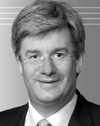
Saul Eslake
Program Director, Productivity Growth
Grattan Institute
Saul Eslake became widely recognized as an economic commentator during his 14 years as Chief Economist at the Australia & New Zealand Banking Group (ANZ). Prior to that he had been Chief Economist at McIntosh Securities, a stockbroking firm (now Merrill Lynch Australia) and Chief Economist (International) at National Mutual (now Axa Australia).
Saul left ANZ in August 2009 to join the Grattan Institute, a 'think tank' affiliated with the University of Melbourne, as Director of its Productivity Growth program, and to continue writing and speaking independently about a range of economic issues.
He has a first class honours degree in Economics from the University of Tasmania, and a Graduate Diploma in Applied Finance and Investment from the Financial and Securities Institute of Australia. He has also completed the Senior Executive Program at Columbia University's Graduate School of Business in New York.
Saul was a member of the Howard Government's Foreign Affairs and Trade Policy Advisory Councils, and for 14 years a member of the Tourism Forecasting Committee. He is a member of the Rudd Government's National Housing Supply Council and was also a member of the Long-Term Tourism Strategy Steering Committee, which completed its report in May this year. He attended the Prime Minister's 2020 Summit in April 2008.
Saul also maintains links with Tasmania, his home State, as a Board Member of the University of Tasmania Foundation, Chairman of the Tasmanian Arts Advisory Board, and as a non-executive director of Hydro Tasmania, Tasmania's State-owned electricity generation business.
|
|
|
 |
|
Scott Haslem
Executive Director and Chief Economist
UBS Australasia
Scott Haslem is an executive director and the chief economist for Australasia at UBS. He was rated the number one economist in the 2005 through 2008 Australian BRW Equities Market Report. Scott heads up the UBS economics team, which in 2006 ranked number one in the Australian BRW Equities, Asia Money and Australian & US Greenwich Institutional surveys.
Prior to joining the firm, he spent seven years working for the Reserve Bank of Australia, primarily in the Economic Activity and Forecasting section. Scott holds an honours degree in economics (1990) and a masters of economics degree (1994) from the Australian National University.
|
|
|
 |
|
Dr Shane Oliver
Head of Investment Strategy and Chief Economist
AMP Capital Investor
As head of the Investment Strategy and Economics team, Shane is responsible for AMP Capital Investor's diversified investment funds (with roughly $A17bn in assets). Shane is also responsible for providing economic forecasts and analysis of key variables and issues affecting, or likely to affect, all asset markets.
In his capacity as AMP Capital Investor's Head of Investment Strategy and Chief Economist he is a regular media commentator on major economic and investment market issues. He has extensive experience analysing the relative return outlook between the key asset classes including fixed interest, property and equities, and their relationship to the investment cycle.
Shane was appointed Chief Economist in December 1994 and Head of Investment Strategy and Chief Economist in January 2001. He has also completed a Doctorate investigating speculative behaviour within investment markets and the validity of the Efficient Markets Hypothesis. |
|
|